
We’re witnessing a fundamental shift in how humanity approaches aging. The year 2026 marks a turning point where longevity is no longer framed as something futuristic—a promise tied to labs, breakthroughs, and distant timelines. Today, it’s being talked about very differently: less as a finish line, more as a way of living.
The focus has shifted toward everyday behaviors—how we sleep, how we move through our days, how we manage stress, and even how our environments shape those choices. Longevity, in this sense, is no longer about chasing extremes. It’s about building conditions that make health easier to sustain over time.
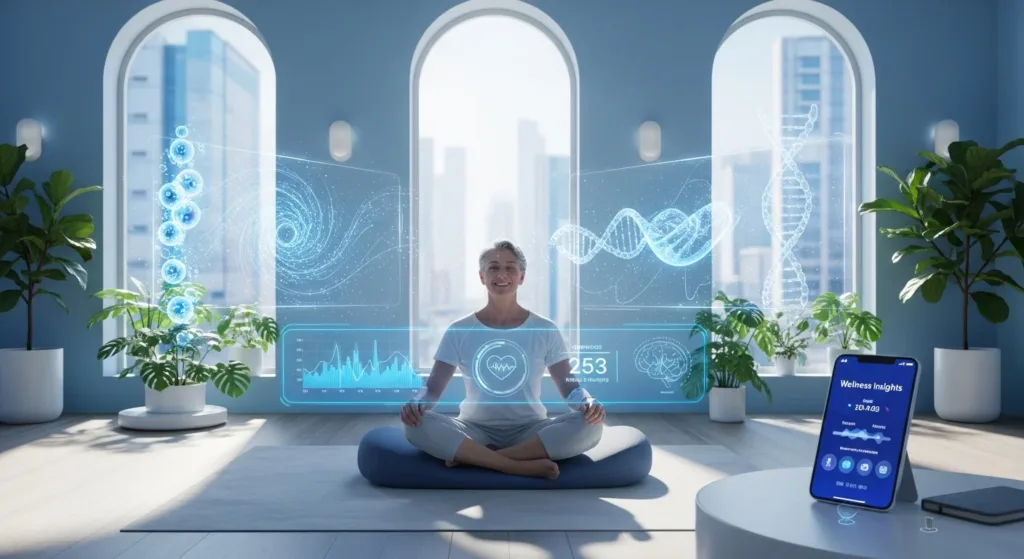
The Longevity 2026 Ecosystem: AI-Powered Personalization
Thanks to AI-powered protocols, our understanding of health is fundamentally changing. Wearable technologies with integrated AI are transforming body data into real-time “digital health twins”—comprehensive data sets that go far beyond simple step counting.
Your Digital Health Twin
By 2026, wearables monitor:
- Voice tone analysis: AI professionally tracks stress levels and mood from microscopic changes in your voice
- Respiratory and cognitive monitoring: Lung health detected instantly from breathing patterns, with early signs of cognitive decline identified from speech quality
- Real-time micronutrient tracking: Micro-sensors monitor vitamins and minerals in the blood, generating personalized nutritional prescriptions via AI
- Continuous glucose monitoring (CGM): Once reserved for diabetics, now used by health-conscious individuals to understand how their bodies respond to different foods
Smart Molecules, Not Random Supplements
In the Longevity 2026 ecosystem, dietary supplements are no longer used randomly. “Smart molecules,” identified through personalized blood analyses, are preferred to support ATP synthesis (cellular energy production) and reduce oxidative stress.
NAD+ precursors and senolytic compounds like spermidine and fisetin actively participate in the processes of cleaning up aging cells. These aren’t shots in the dark—they’re precision interventions based on your unique biology.
The Biohacking Shift: From Pushing Harder to Supporting Better
One of the clearest changes in the longevity space is the move away from constant optimization. Instead of asking how far the body can be pushed, many practitioners are now asking how it can be better supported.
Heat and Cold: From Fringe to Fundamental
For longevity enthusiasts, “heat shock” and “cold exposure” have ceased to be marginal practices and become an indispensable part of daily routines. These practices aim to trigger cellular renewal through hormetic stress—small doses of beneficial stress that make your cells stronger.
The science is compelling: controlled exposure to heat (saunas, hot baths) and cold (ice baths, cold showers) activates protective cellular mechanisms, improves mitochondrial function, and may extend healthspan.
Environment as Medicine
Homes and workplaces are increasingly viewed as active contributors to well-being. Sometimes that means technology; often it means simplification:
- Quieter evenings to support circadian rhythm
- Better lighting choices that match natural light patterns
- Clearer boundaries between work and rest
- Sleep temperature optimization
- Light spectrum adjustment at home to match circadian rhythm
The most effective environments tend to be the ones that reduce friction rather than add complexity.
The Dark Side: The Longevity Trap
There’s an old adage in medicine: The dose makes the poison. Even healthy things become dangerous if overdone—and the quest for longevity is no exception.
When Optimization Becomes Obsession
Paying attention to what goes into your body is all well and good. But if you’re so fixated on optimizing every meal that you can’t enjoy your own birthday cake, things may have gone too far. Being able to break the rules, on occasion, is just as important as following the rules.
The DIY Longevity Underground
Today’s biohackers have 24/7 access to the underbelly of the anti-aging world. A network of dubious telehealth clinics, compounding pharmacies, and direct-to-consumer websites makes it almost too easy to buy all kinds of alleged anti-aging therapies.
Take peptides, a wide-ranging class of amino acids that includes synthetic hormones, GLP-1 drugs, and experimental compounds. Many are not approved for medical use, yet people are buying them online.
For a certain subset of longevity warriors, even NAD+ infusions and off-label rapamycin barely register as extreme:
- Clandestine trips abroad for gene therapies unapproved in the United States
- Off-label plasma-exchange therapy—removing old blood plasma and replacing it with fresh fluid
- Untested supplements and shady stem cell injections
Emergency medicine doctors are seeing the consequences firsthand. Often, since providers don’t know a lot about these experimental treatments, don’t have records, and they’re not approved, it’s hard to even research them when patients arrive in crisis.
The Safe Path Forward
Legitimate doctors encourage sticking to evidence-backed basics rather than going extreme. As emergency physicians note, there are far better ways to extend your lifespan and stay out of the ER. To start? Wear your seatbelt. Exercise consistently. Eat real food. Get quality sleep.
The NAD+ Phenomenon: Hype vs. Reality
NAD+ (nicotinamide adenine dinucleotide) has become one of the most talked-about supplements in the longevity space, championed by celebrities from Hailey Bieber to Jennifer Aniston. Google searches for NAD are predicted to soar 10% within the next year.
What Is NAD+?
NAD+ is a molecule that exists in every living cell in your body. Think of it as cellular currency that helps convert food you eat into energy your cells can use. It’s also essential for DNA repair and other cellular maintenance processes.
The challenge is that NAD+ levels naturally decline as we age—potentially dropping by as much as 50% every 20 years. NAD levels start sliding as early as our twenties and may drop to roughly half by age 50.
The Promise
In lab studies, NAD+ precursors like NR (nicotinamide riboside) and NMN (nicotinamide mononucleotide) can increase NAD+ levels by 40-90% in the short term. Animal research has shown promising effects, including:
- Improved insulin sensitivity
- Better cardiovascular health
- Enhanced brain function
- Increased muscle function
- Enhanced cognitive performance
The Reality Check
While NAD+ supplements can raise NAD+ levels, there’s no proof this translates to improved longevity or health status in humans. Here’s what experts say:
The evidence is limited: Human clinical studies have confirmed that supplementation can increase NAD+ levels, but long-term functional effects on health remain limited.
Safety questions remain: Long-term effects are unknown, and safety questions—particularly regarding cancer risk—are not yet settled.
IV infusions may not work as advertised: “In very plain words, intramuscular and IV NAD+ intake is silly,” says Eric Verdin, president and CEO of the Buck Institute for Research on Aging. NAD+ infusions may increase the molecule in the bloodstream, but not in the cell as much.
The Better Approach
You can increase NAD+ levels naturally without expensive supplements:
- Exercise: One of the simplest ways to boost NAD+ levels. Lift weights—lift HEAVY weights
- Maintain a lean body weight
- Eat NAD+-supporting foods: Avocados, meat, edamame
- Increase protein intake to account for muscle composition and muscle protein synthesis
If you do choose to supplement, oral NAD+ precursors (NR or NMN) have fewer side effects than IV infusions and are more beneficial. They help regulate circadian rhythm and support detoxification. Some practitioners recommend them for patients who need more energy, experience brain fog, or have long COVID.
Women’s Health: The Menopause Moment
With over 47 million women transitioning into menopause annually worldwide, the conversation is impossible to ignore. A major study has revealed concerning links between menopause and brain structure changes.
Brain scans showed grey matter loss in areas tied to memory and emotional regulation, while many women reported increased anxiety, depression, and sleep disturbances.
The good news? In women’s health, cycle-oriented living and hormonal balance management are transforming into fully personalized strategies with the support of artificial intelligence. Exercise appears protective—research shows that those who maintain consistent physical activity often report better management of symptoms and preservation of cognitive function.
Longevity with Soul: The Missing Variable
As biohacking becomes increasingly high-tech, a countermovement is emerging. We’ve mastered the science of extending lifespan—from cellular regeneration to AI-powered diagnostics—yet we’re missing the most critical variable: the soul.
The latest research confirms what ancient traditions have always known: people with strong spiritual practices and sense of purpose live not just longer, but better, with studies showing up to 33% increased longevity in those with regular spiritual engagement.
True longevity isn’t just about adding years to life, but about adding life to those years through purpose, meaning, and spiritual connection. The result is a new paradigm: longevity with soul, where the question isn’t just “how long will I live?” but “what will I live for?”
The Global Longevity Movement
Major conferences are bringing this community together:
Biohackers World Conference & Expo
March 28-29, 2026, in Los Angeles, expected to host 1,500 attendees, 35 speakers, and 65 wellness and longevity brands. The gathering brings researchers, thought leaders, founders, and practitioners to examine how longevity is maturing—from niche self-experimentation into a more grounded, evidence-informed field.
L’Hypersanté – Paris 2026
March 21-22, 2026, featuring 35 conferences and 20 hands-on practical sessions covering cutting-edge topics including biohacking techniques, nutrition, fitness, mindset enhancement, nootropics, advanced technologies, sleep optimization, biological age assessment, breathwork, ice baths, oxygen therapy, and red-light therapy.
Biohacking & Longevity Summit Kuala Lumpur
January 24-25, 2026, exploring the latest breakthroughs in biotechnology, AI wearables, nutrition, and regenerative medicine through interactive sessions and live demonstrations.
What This Means for You
The longevity landscape of 2026 is about returning to fundamentals while leveraging modern science. Here are the key takeaways:
- Personalize, don’t generalize: Use technology to understand your unique biology, but don’t assume one-size-fits-all solutions
- Build supporting environments: Your home and workplace should make healthy choices easier, not harder
- Embrace proven basics: Exercise (especially strength training), quality sleep, stress management, and whole foods remain the foundation
- Be cautiously optimistic: Exciting developments are happening, but be wary of extreme or unproven interventions
- Find your purpose: Spiritual connection and meaning may be as important as any biohack
- Think holistically: Longevity doesn’t require constant intervention, but it does require intention
The Bottom Line
The future of longevity likely won’t arrive as a dramatic breakthrough. It will take shape more quietly, through better habits, better environments, and a clearer understanding of how small choices compound over time.
As interest in preventive health continues to grow, we’re at a checkpoint—a moment to assess what’s working, what’s overhyped, and what’s coming next. The most effective longevity strategies aren’t about doing more; they’re about doing what’s repeatable, sustainable, and grounded in both science and lived experience.
Longevity in 2026 isn’t about chasing immortality. It’s about building a life worth living for as long as possible—with energy, purpose, and vitality intact.
What aspect of the longevity revolution resonates most with you? Share your thoughts and your own longevity practices in the comments below!
Michele Jordan is a Physical Education professional specialized in Pilates and functional training. She writes about movement, wellness, and healthy aging at Nutra Global One. Read more: https://nutraglobalone.com/about-michele-jordan/